Tuesday, May 6, 2014

Rude, Mean or Bullying?


Rude, Mean and Bullying


 This ancient bridge connects two opposite sides or banks.  Similarly, education connects the known with the unknown and equips learners with tools to build better relationships in their future.

At the middle school, we do so many different things surrounding the support of a child's growth and development.  We work on social situations, mental processes, academic advancements and self-awareness.  We talk about manners and making others feel comfortable.  In short, we try and make citizens of these people, all while trying to get students ready for the regular high stakes testing.  Another blog initiated a conversation over these following terms.

Define Rude. Discourteous or impolite
Their actions may be rude, when students do not realize the pain they cause another person.

Define Mean.    Offensive, selfish, or unaccommodating; nasty; malicious: 
When mean, the student knows and is intentionally trying to make another suffer or feel bad about.

Define Bullying.   A blustering, quarrelsome or overbearing and habitually badgers and intimidating smaller or weaker people.
The bully repeatedly displays mean and or rude behavior to a specific student or students.  There is no sign of the behavior ending and the victim often feels powerless to control or manage the attacks or the feelings of helplessness that follow.

Victims 
Those of us on the receiving end seldom consider the title of the behavior.  We just know how we feel during the event how we hurt afterwards as we consider what we might do to work through the pain.  We may even consider retaliation, revenge or making someone else hurt perpetuating the viscous cycle. 

Culture
Middle schools invest time, energy and substantial resources on breaking this cycle and helping students with empathy.  It is a continuous, mufti-faceted approach battling on the home-front, cultural issues, in the cafeteria and buses as well as the occasional classroom remark.

Mirrors
On the other hand, students acting out towards others, often times their friends, think they are just being funny, or they were just messing around.  These seemingly harmless remarks often go unchecked and unaddressed but are the most detrimental.  For instance, if an enemy would make an attack, a victim might excuse or ignore the infraction.  On the other hand, friend saying something may actually get our attention and provide doubt confusion or even insecurity.  This same friend may themselves struggle with confidence and esteem issues and overcompensate perceived shortcomings trying to mask or hide behind bravado!  Here is where empathy, understanding, training and finally consequences are in order!

How are we mean?
What do we do that is rude?
When do we bully others?

Monday, April 21, 2014

Good schools make an area? or Does the area make the schools?

All across Missouri and this week at Winfield Middle School, we are beginning our annual rite of spring, the MAP tests.  Teachers are nervous.  Administrators are jumpy. Students are excited to have a messed up routine.  Our testing coordinator is extra busy.  Some might even loose a bit of sleep.

This QR Code holds a message for the students to consider?  What does it mean?

We asked students today in preparation for their MAP tests to consider a simple request:  
TO DO THEIR VERY BEST!  
We understand the stakes involved, we know the motives may or may not be true yet we made a request for them to try hard.

WHY? 
What would it matter if anyone ever did well on these exams?  What would the motivation be behind giving the best effort?  Why would it even be important?

Pride in accomplishment
Of course we all pay lip service to doing our best, claiming we are trying to improve and we are working towards a better tomorrow.  That sounds nice but here is a wonderful opportunity to verify those intentions. 
Property Values
Whenever anyone moves, one of the first questions the potential buyers seem to ask is, "Tell me about the Schools?" This also verifies the perceived or actual value in good schools.  Marketing principles support the ideas that good school may actually raise property values faster than the general market, making some areas highly desirable but other areas flat or declining.   Are good schools in the area because the area is good, or is the area good because the schools are good? 
Selfish
We value the students effort but only ask them to do their best one time.  We believe that doing our jobs, building relationships with all of them and forming an environment of learning for all with a high bar for behavior as well as academics does far more than bribing, begging, pleading or even bargaining!  Students don't care how much we know until they know how much we care!  Students know if we care, or if it is just an act!  Good schools produce good scores and good scores reflect on the leadership!  We want our students to look good, and we might be the only ones that care!
De-Coding Skills  
When I was in school... 
Our students will enter a world that we cant even begin to describe.  The class of 2020 will face obstacles and issues that arent even developed yet, so we work to equip them with processing tools, thinking skills, infering practices, taking from something concrete and working towards the abstract.  We are asking them to solve problems that don't even exist yet!
ANSWER:
The QR Code above, easily made at many online sites takes information and processes it into smaller bites, linking back to the internet of sharing data directly.  Just as a long web address reduces into a tiny address, there are many shortcuts, abbreviation and quicker ways to communicate.  What other new things will our students face as they mature into leadership positions in the communities?

We are preparing students for their future!  Not our past!    Winfield Middle School is #onthemap.

Monday, April 14, 2014

Support or Help? What do we supply?


Below is a representation of support!

This motor needed a new water pump. Right behind the middle pulley is the water pump.  
Was it help or support that aided in the replacement.
 
This broken engine, repaired by following the written instructions in the manual,  represents an example of the application of support.

The car broke down by the side of the highway with a sign that says, "send help," is an example of help!
SUPPORT IS...
Support is necessary to help others get through things.  "Getting through," is the key.  With support, a student can solve a problem.  Support lends itself to self-sufficiency.  Confidence and self esteem are also strengthened when support is offered, as opposed to help.
Support implies a bit more independence than help.  Help implies the situation is too dire to face alone and aid is required.  The broken down car, stranded by the side of the road is trapped and short of a long walk to help, nothing can be down!  An offer of help may imply dependency!   Consider a toddler trying and exploring a new skill or task.  Often times, they want to try it alone. 
HELP IS...
For instance, an overprotective guardian may actually weaken the youth by becoming the crutch.  Teachers continuously look for this line or sensitive cusp, ready to support, encourage and prompt into mastery.  The consummate educator understands and sets up opportunities just outside the comfort level or reach of students knowing students own success when it is authentic.  Students can read between the lines when looking for artificial concern.  They recognize true interest and care.
This "key lime pie" was made as a gift.  The recipiant did nothing but recieve it.  No help could have made it better.  (It might have even made it worse!)
Here is a picture that could represent help.  It was birthday gift from a chef who specializes in pies.  There were no contributions from me necessary to complete the task.  Her gift was helping me.

In our lives, how much help do we offer when support is all that's needed? 
When do we step in too early and eliminate the risks, as well as the value for our students? 
Our students want as little help as possible but as much support as needed to reach their goals.  They want us to use our experience to support them and step in to help, after their risk taking events failed them, without judgement or condemnation.

Provide support, and offer help, when only needed.

Wednesday, April 2, 2014

How long does it take to grow a PINEAPPLE?

Anniversary:

My wife and I visited Hawaii for our one year anniversary.  We island hopped, took the road to Hanna, explored the volcanoes on the Big Island, attended a luau, and ate our share of perfect pineapples.  Interestingly enough, pineapples have a different growing cycle then most our our mainland fruits or vegetables.  As expected, time and temperature conditions indicate the success of the pineapple crop.
 In the St Louis climate, these tropical plants have to be put into a green house to weather the winter extremes!  Like a relationship that takes extra care to fully blossom.

Teachers are:

Teachers end up in the unique opportunity of service through connection.  School years have 175 days.  A gardener knows this is enough time for growing many vegetables.  Tomatoes, peppers, vines and even potatoes can all be planted and harvested in one typical growing season on most of the U.S.  Six months is not enough time to grow a pineapple though!
This morning flower of the bird house gourd opens in the dark and closes as the summer sun warms it. Like the beginning of a school. 

Classrooms are:

In the classroom, a teacher spends the first portion of the year building relationships, looking for common interests with students.  Gone are the days of "don't smile till Christmas."  Teachers serve the future by serving children today.  Teachers are intentional and deliberate.  Many teachers are not satisfied with the the phrase, "If I only reach one student, it is all worth while."  These extra special teachers reach children continuously, day in and day out.  Every one of her students receives more then just a history lesson.  Life lessons, manners and social competency pointers, just to name a few, make up the substance and thought processes of these special people.

What do our students remember the most?

This influence is unique to the profession.  Teachers teach because of the impact they know their presence makes.  They understand the biggest changes occur when they reach children.  To reach children, they develop those relationships based on shared and regular activities, like class or lessons.  Then, when students lives outside the classroom seep into school, a teacher is there to offer hope encouragement and support, like no other adult in the students lives.  These masters of impact know the students will learn under their tutelage.  These rock stars shape the climate of today.  But these champions know the children cherish the way she makes them feel.  The master know students remember the way their great teachers build their esteem, self confidence and 
After a few months of growing season, many things begin to mature, ripen and come to fruition simultaneously, forming diverse and colorful living flowering arrangements.  Like a classroom in the spring time.

Timing is everything

Just like a pineapple that take 18 months to ripen some relationships, take longer then others before a student maximizes the benefit of the healthy teacher-student relationship.  Most relationships take only a short time to develop.  The truly valuable relationships often take a bit more time.

Saturday, March 1, 2014

Love Works

COMMITMENT:


COMMITMENT
We will not Waver: We will not Tire:  We will not Falter:  And we will not Fail. 
G.W. Bush 2001
(From our middle school office wall) 

What do you remember from school?  Courses, content, lunch, gym class, friends or trouble?

This seems like a strange title for a business book.  Business typically seems focused on the bottom dollar yet anomaly and exception dot the landscape.  Good to Great, Malcom Gladwell, The Way of the Shepard and this Love Works, are just a few endorsing a compassion based priority where people actually come before profits. Case study and anecdote alike verify the effectiveness of building relationships as a means to the ends in many ventures!  And this is the business world.

Now consider the educational system today.  Teachers spend 175 days a year with groups of students.  A grade or topic is assigned, curriculum assembled and assessments tallied!  Then we do it again.  Over and over in order to perpetuate our society.  A democracy requires an educated population.  

This responsibility or burden is publically assigned the classroom teacher!  Of course the family retains ultimate and direct influence but our system carries the load.  One look at state budgets confirms the value society places on education.  But clashes, conflicts and concerns arise when these are not aligned: 

When children are taken advantage of by selfish adults
When sarcasm replaces compassion
When a raised voice is chosen over a conversation

These examples are just a few indicators of holes in our systems.  Of course we can point fingers of blame, develop initiatives of influence and tout the need for change but without the effective teacher, nothing will happen.  Status quo is not good enough for everyone.  We can't allow our youth to loose their hope.  

Buried in this essay...
A teacher is often times the best instigator of hope or fear in a child.  Basic needs such as routine, security, procedures and safety are often lacking in students lives, TILL THEY MEET THE TEACHER! Once The Teacher enters the life of a student that has given up hope, all bets are off!  The Teacher changes lives.  The Teacher uses a content, subject matter, lessons, daily routines and habits to reach into a students life, then makes a connection.  After this crucible called a classroom has endured the messy tests of relationship building, The Teacher has an opportunity to make incredible impacts by influencing students like no other adults in a students life!  The Teacher models hope, inspires, and changes the course of life after life! The Teacher influences today and tomorrow.   A single, influential teacher can't help but to influence.  After so much time is spent together, impact is inevitable. The Teacher inspires hope.  Hope is the positive motivator of change.  

Fear is the negative influence of change. 

The relationships good teachers have with struggling teachers build the foundation for success.  Just how the business world applies relationship skills the effect the bottom line, teachers use them to effect  lives.

Quotes, thoughts and tags:
A rut is just a grave with the ends kicked out.
Good discipline does not diminish hope.
Hope and fear are the two motives for human behavior!
The teacher comes along when the pupil is ready.

Keep up the good work!  Think outside the box!  Use all the supports available.  Love them all.  What happens now is FINALLY serious.  Everything up to here was shallow, yet foundational to the impact currently underway.  This part is the process.  Influence is not an event but a process!  :) 

Wednesday, February 19, 2014

Caught or Taught?


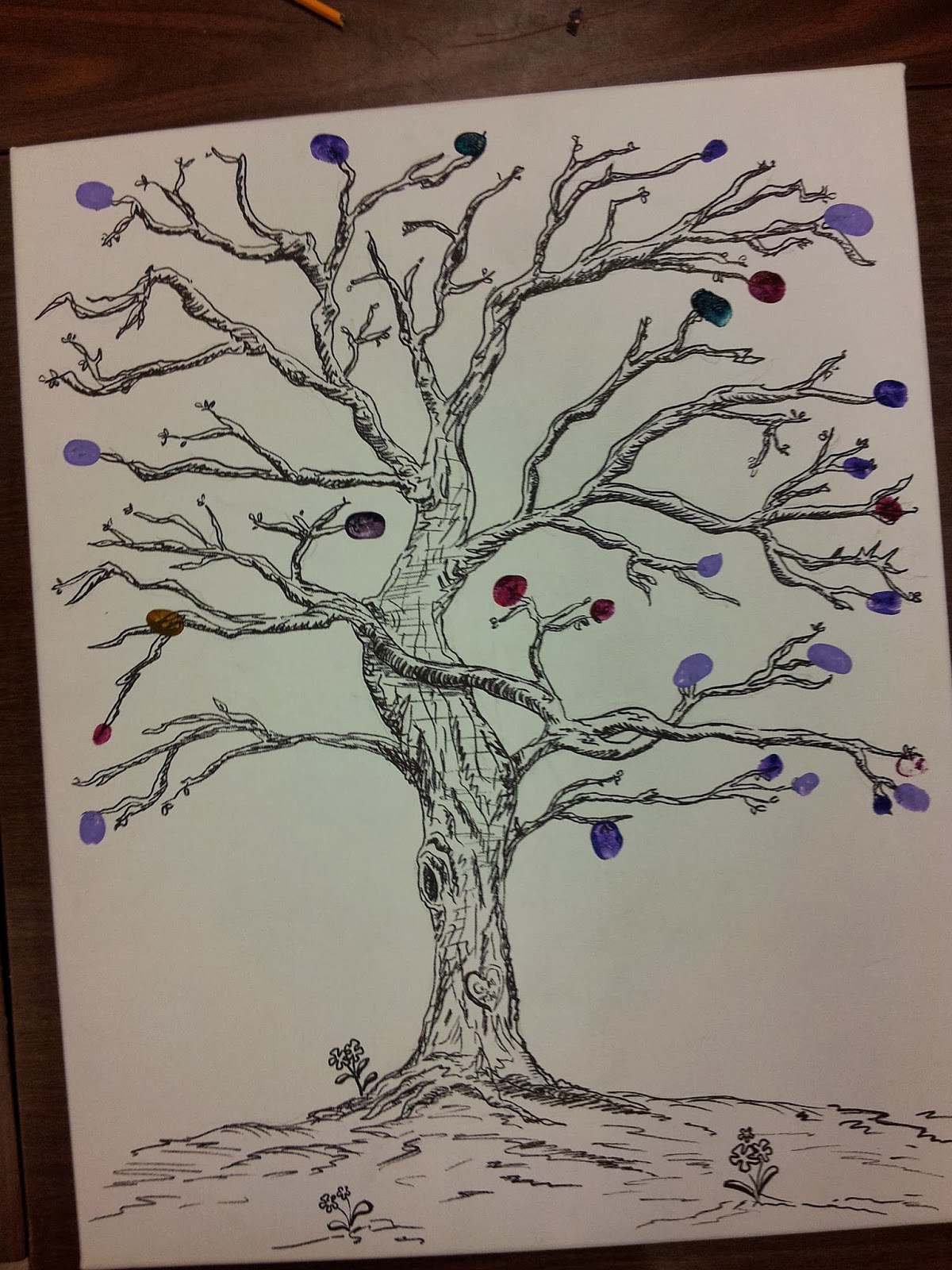
Here, our students have assembled their thumbprints in an expression of support to one of our staff members. 

THE IDEA
It all began in the hallway during a chat about the impending assembly.  A MATH teacher mentioned in front of the ART teacher an idea about all of us contributing something together.  All we needed was a winterized tree on canvas.  The ART teacher addressed that situation and brought in the tree, painted on a canvas, 22x28 inches framed, the very next day!
THE EXECUTION
The students were next!  During their health and PE classes, they traveled to the ART Room where palettes of various shades of purple were ready to sample.  Each student's thumb was moistened with paint, then blotted on a page, then imprinted in any location on the tree.  Care was taken to have all the leaves attached and successfully filling out every branch.  (Parenthetic note:  Every student acted on their best behavior while they had a potentially messy hand!  Well done, students!)
In addition to all the staff in the current building, other district staff were invited to participate by sharing their thumb print as well.  The final project was presented at a school wide assembly. 
THE MOTIVE BEHIND
The middle school setting can be a place of great extremes.  Emotions can run high or low, peeks and valleys, all before breakfast.  The adventure of the middle school makes it so exciting.  Yet alone with the adventure is the drama that sometimes follows.  Our intent in a school-wide project like this was to broaden students' perspective.  This collaborative piece shows how we can altogether become bigger than just ourselves individually.  By looking at others, we take the focus off ourselves.   Watching how others battle situations, working through stress and displaying healthy choices shows how many things are caught and not taught!
The lessons range from narcissism and self-centeredness to the differences between empathy and sympathy; not to take advantage of a situation but to learn life lessons in every situation.
CONCLUSION
Working through the little distractions at school is preparation for the real challenges of life.  At school, there are supportive adults to guide and offer coaching.  After school, many begin playing without the safety net of their teachers and parents.  At our middle school, we strive to guide them towards success, one issue at a time!

Friday, February 7, 2014

#TBT Once a champion, always a champion!

 Proving things to others! Proving things to self!

This patch serves as a concrete reminder of a prior championship. 
Once a champion, always a champion?
 
Being Throw Back Thursday, #TBT, a friend of mine posted a picture of his highly successful high school cross country team.  They were holding the over sized trophy of a Missouri State Title!  The day was a culmination of days, weeks, months and in some cases, years of training in preparation for this day.  Each of them had run mile after mile, spend hours in mental contemplation, practiced both anaerobic and aerobic workout routines, sprints, miles and carb loading.  All of this is in part, due to their focus on building a championship.
Champions:  Built or Born?
Interesting things about the formulation of champions.  It is often a process, driven by doing things differently.  Talent is only a contributing factor.  The real process happens in the crucible of stress, practice and preparation.  For these young men, establishing this high bar was the expectation.  Winning became the norm.  Winning was habit!
Accentuate the Positive! Opponents, Teammates, Self!
Aligning their thinking began the process.  Coach prompted them to leave the trash talk about and to other teams out of the situation.  The only thing worse than a sore loser is a sore winner.  Respect and honor were actions words describing the opinion of other contestants. Well, if negative talk was not allowed to reach other teams, would it be allowed within the circle?  A resounding NO!  Team mates were not to talk trash to each other as well.  Spending so much time together mandated they behave like gentlemen and in a sportsmanship like manner. Even if they did not yet believe it, they were to behave like it!  Finally, and the hardest to break was the mental self talk.  The runners actively reprogrammed themselves to eliminate the negative self talk and replace it with affirmations, positive mental images and encouragement!  This reprogramming is not unique to this situation.  Substantial anecdotal and scientific evidence support the need for a positive mental attitude.
Physical or Mental?
The physical aspect actually followed the mental aspect.  Of course, athletic interviews are always more interesting when the athlete talks about the mental aspect of the game.  Exercise routines never make prime time sound bites.  Instead, the talk reported more often addresses the internal battle going on inside the contestant's mind!
Once a Champion, Always a Champion!
Finally, the #TBT posts of times in the past endorse the idea of sustaining championships.  Lindbergh won that meet and those runners all contributed to the success.  Yes, Bryan won that race. But together, they achieved more than any other team prior!  Their success hinged on each of them maintaining peak mental and physical conditioning.  Each of them became a champion and that would never be stripped, pulled or taken from them.  History documented their influence on the record books and it will not be reproduced, ever.
In the story, The Velveteen Rabbit, the rabbit wants to become real!  Once he achieves that status, it is permanent.  Once a champion, always a champion.  It is permanent!
Well done, Lindbergh Cross Country Team
Applications:
Watching the teachers at Winfield Middle School work with their students prompts further questions about champions.  Since these teachers act like champions, are they champions?  They unknowingly model and emulate winners, so are they winnders?  Do they act that way because they believe that way, or do they believe like that and act accordingly?  Do their actions influence the outcomes?  Do they act that way because their jobs require it?  Regardless, there are champions throughout WMS!

Photo credit to: Bryan Blackford.