 |
| This museum overlooking Los Angeles is aligned with both the mountains and the highway, deliberately. This wall and Hwy 405 in LA are laid parallel. This structure was designed to complement the surroundings. As leaders, do we complement or work against our environment? |
Monday, June 17, 2013
Know yourself to know others! Try the Kolbe A profile.

Monday, June 3, 2013
What would you do with 3 hours of free time?
Vacation
blog! Oxymoron?

Another
interview question: What would you do with 3 hours of free time? Three days? Finally, three weeks?
Consume
or improve? Most people I prompt answer
in one of these two ways. Some are willing to
admit they would spend time investing in themselves, taking care of personal needs
or wants. Others would fill their time
with helping others, often creating energy from energy by getting their energy
from others. Is one more impoartant than the other?
In
either situation, taking care of self is just as important as taking care of
others.
Those
taking care of themselves first may be adhering to the advice given on a plane,
as mentioned in an earlier post, when the steward says "in the unlikely
event of a drop in cabin pressure' please put the drop down mask on
_________?_________ first? Does she say
to put it on your child first, or yourself first? Of course, she says to take
care of yourself first. Unless we take
care of ourselves first, we will be in no condition to assess and address the
needs of others! Many recognize their
needs and even identify and articulate the issues clearly but without the
ability to follow through, our understanding s in vain! We won't be able to help. Recollections from mountaineers struggling to
conquer mighty obstacles often pause when the servant attitude implies we take
care of others first.
On the
others hand, folks often find energy serving and taking care of the needs of
others. This drive, passion or even gift
often times lurks in the background.
This servant works to put others in the limelight, spotlight and center
stage. A true servant is motivated to
put others first. How does this align
with our earlier thought of take care of ourselves, before we can take care of
others?Another option may be a combination of both! In an attempt to simplify, we may have oversimplified! Maybe we can't enjoy an either/or situation? As I sit here, unwinding and trying to enjoy a week of vacation, I struggle with feelings of guilt for not doing enough. I struggle considering to myself, I should be working on something. I am distracted thinking this time a loss in productivity! But then I wonder if I am doing myself a disservice by not truly letting things go and unwind. What or where is the balance? Is there a balance or is it all or none? Will it be alright? Will everything get finished?
Yes, there is value in both work and relaxing.
Conclusion: Work hard to relax during vacations! Those in our teams deserve our best.
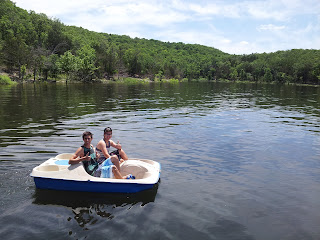
picture credit: Table Rock lake, Lampe Missouri photo by author of ZGR and SBG. (Happy b day SBG)
Tuesday, May 28, 2013
Fear or Hope? What is a better motivator?
Q: Movie Line: "Hope! It is the only thing stronger than fear!" What recent film claims hope is a greater motivator than fear? (answer below)

Off in the distance, we see Table Rock Lake. Does a spanning vista like this inspire hope or fear? Does this big picture drive us to do more, or fold our hands and quit?
(From Young Life's Clearwater Cove lookout peak)
Assembling
all these quotes leads me to believe in the wisdom of those before me,
considering their experiences, thoughts and perspectives worth regarding. Asking questions about what they thought
important, why they thought it important and how it applied to their situation prods
me to continue in my own quest of understanding. What follows are the quotes in italics, the
author in bold and my remarks, for what they are worth.
The greatest mistake a man can makes is to
sacrifice health for any other advantage. A. Schopenhauer Money, power, importance, control, being right, being the best or any other aspirations do seem subordinate to health.
Our bodies are apt to be our own autobiographies. F. Burgess
What story are we writing?
I tell you the past is a bucket of ashes. C. Sandburg
Cynical, accurate or perceptive?
Knowledge is power. F. Bacon
It's both how we get the knowledge as well as what we do with the asset.
Perhaps the most valuable results of all education is the ability to make yourself do the very thing you have to do when it ought to be one, whether you like it or not. This is the first to be learned. T. Huxley
That sounds like a good definition for self-discipline.
It's great to be great but it's greater to be human. W. Rogers
What is really important? Being a contributing member of the community?
The greatest happiness you can have is knowing that you do not necessarily require happiness. W. Saroyan
It's like joy and happiness are closely related, but not the same! Happiness seems based on external situations or circumstances. The pursuit of happiness drives our foundational documents, as well as our economy, yet inner joy, peace or contentment have another source. Not based on our plight but stemming from some inner drive, motive or security, the greatest happiness is recognizing happiness is optional.
Even when the experts all agree, they well may be mistaken. B. Russell
Experts are experts, but data should drive, inform and influence the experts. Without the data, the experts are just telling stories.
A committee is a group of the unprepared, appointed by the unwilling to do the unnecessary. F. Allen
Without norms, clear purposes and leadership, this can be true. However, with a clear objective, leadership and manners, a committee is an example of synergy!
If you respect your job’s importance, it will probably return the favor. L. D. Turner
Persistence, staying power and the ability to outlast others often defines the champion, since he does what others do not do!
An expert is a man who has stopped thinking he knows. F. R. Wright
Maturity, experience and mistake after mistake reveal to us there is always more to learn, complete and conquer. The life-long learner gravitates to the status of expert due to their quest for understanding. To consider knowledge and wisdom as complete or sufficiently amassed implies
I do not believe in the collective wisdom of individual ignorance. T. Carlyle
So what do we “believe in?” Majority may not know the best. Wisdom and understanding may have an alternate perspective.
If fifty million people say a foolish thing, it I'd still a foolish thing. B. Russell
Remember “Animal Farm” by George Orwell to get a matching point of view.
I've got to follow them, I am their leader. Ledru-Rollin
Admittedly, I had to search out the back-story of this politician as he worked to represent the oppressed masses.
Make the most of yourself for that is all there is of you. R. W. Emerson
We spend time trying to be somebody else, when we should be just be ourselves, content in that but giving it everything we have.
Yes, these quotes are concise. My words add little. Yet the focus, concentration and deliberation to expound on each quote add insights and hopefully wisdom. Only time will prove it effective!
Answer: In The Hunger Games, the President Snow, played by the esteemed Donald Sutherland, asked the game-maker Seneca Crane played by Wes Bentley "Why do we have a winner?" As the ruthless president of the post-modern world, he frequently ponders motivation of the masses. In reply, Crane stumbled through a response but Sutherland answered his own question. He posed a "little bit of hope is effective but a lot of hope is dangerous," then reiterates that a "spark is fine, as long as it is contained!" What pressure do we apply when we motivate our students, in fear, or in hope. Which is more effective? Which reaches the hearts of our students? Which is more lasting? Fear drives today but hope inspires for tomorrow!
Friday, May 24, 2013
Build Bridges or Walls?
Build bridges or walls?

Concise,
direct and an efficient use of words and terms allow us to communicate directly
and effectively. When talking with
others, we try to communicate ideas but often, fail to transmit the pure
thought. One great thing about quotes is
their ability to communicate an abstract concept into a simple thought. These following quotes were all pulled from
the The Treasure Chest. Which are your favorites?
Men build too many walls and not enough bridges. D.
Pire
Walls
are simple to build but bridges take a bit more attention to assemble. In the same way, healthy relationships require
us to reach across differences, gaps, perspectives and stereotypes forcing us
to get along with others that may not align with our way of thinking. A far easier route would be to ignore or even
work against reconciliation!
It gives pleasure to be praised by one whom all
men praise. T.
Howe
The real purpose of books is to train the mind
into doing its own thinking. C. Marley
As an
educator, this is paramount! Think depth
of knowledge.
The slave has but one master, the ambitious man
has as many masters as there are persons whose aid may contribute to the advancement
of his fortune. J. De. La. Brayer
Ambition,
aspirations and a quest for advancement is a common theme. Do we own our things, or do our things own
us?
If ambition doesn't hurt you, you haven't got
it. K.
Norris
A man’s home is his hassle. Mrs. L
Peter
I
thought it said castle, but it is really his hassle.
Ambition is a lust that's never quenched, grows
more inflamed, and madder by enjoyment. T. Otway
Find where your main roots lie and do not
hanker after other worlds. H.
Thoreau.
Keep the
main thing, the main thing.
It seems
like so much wisdom is contained here.
Our quest in reviewing these lies in uncovering common themes that apply
to all mankind, regardless.
Here at
Winfield Middle School, we just finished another school year. As principal, I felt like I learned every day! From the existing staff, I learned about the
current state of affairs. I learned
about their strengths and areas of interest.
I learned about their classroom talents and was eager to see them in
action, molding, opening and forming young minds. Middle School students showed me culture, drama,
the Harlem shake, #dontgiveup and excitement.
A middle school student is singularly an enigma, a joy and entertaining,
all at the same time. Finally, I learned
my own limitations. I learned to let go,
to delegate, to communicate and apologize whenever necessary. I learned where I fall short, areas of improvement
and just a bit of what it means to actually lead. Thanks for following.
#onthemap
#onthemap
Monday, May 13, 2013
Family Traditions
Public Speaking, Toasts and Orations

Traditions,
weddings, celebrations, annual remembrances all point to family get-togethers. Times when generations can meet, compare
notes about today, recollect past occasions and mile marks and speculate about
the future.
Recently,
a cousin was in town from the big city.
It was enough of a reason for us to gather for an impromptu birthday
party. At many of these events, somebody
gets up and starts waxing away! To prime
the topics, my uncle's gift book from 1974 was brought out, the
treasure chest. This book
compiles nuggets of wisdom gathered over time from 2500 years of written
wisdom. There was a summary sheet that
listed some of my uncle's favorite quips.
As I
reviewed them, I could see my uncle in the meaning, but interestingly, I could
see myself. It was a testimony to the
nature of the connections established by strong bonds. Take care of the means and the ends will take care of itself. M. Gandhi
The genius of a good leader is to leave the behind him a situation which common sense, without the grace of genius, can deal with successfully. W. Lippmann
A failure is a man who has blundered, but is not able to cash in on the experience. E. Hubbard
Jumping to conclusions seldom leads to happy landings.
Reformers are those that educate people to appreciate what they need.
A great part of courage is the courage of having done the thing before. R.W. Emerson
There is no more miserable human being than one in whom nothing is habitual but indecision. W. James
Thoughts are but drams, till their effects can be tried. W. Shakespeare
When love and skill work together, expect a masterpiece. C. Reade
Deliberating is not delaying. Ecclesiastics
Let no man presume to give advice to others that he has not first given counsel to himself. Seneca
He who praises everybody, praises nobody. I. Johnson
Strengthen me by sympathizing with my strengths not my weakness. B. Alcott
As I transfer these quotes from hand written cursive script to my iPad, I see wisdom. I can imagine my uncle using them as daily affirmations. I imagine his quest to find truth and trace the path from cairn to cairn. I am also convicted of my own shortcomings, failures and character flaws. Yet I am reminded to persist. I am encouraged to find success and strive for constant improvement. I am driven to push myself to a breaking point.
How can I be a better member of my family? What does my work setting need for me to do differently? How can I take better physical, mental and spiritual health of myself? What does society, the environment and our civilization require of me? What legacy, if any, will I leave behind?
The above quotes are hand written on plain white paper, the first two pages of six, condensed from a publication of 250 total pages. Are they the best? No. Do they contain any extra wisdom? No. They were chosen for their own merit, but still ring true!
Tuesday, May 7, 2013
The Flood or 2013, Cuiver River from Frenchmens Bluff


Sandra
McCracken, my sister, writes a song titled Age to Age. Interestingly, this song is written about
flood waters along the Mississippi, where two boys would play by the water,
along the levy. In the song, the levy
breaks and water and sand overcome them.
Authorities come and pull the one up by the hand and they ask where the
brother is, he replies, "I'm standing on his shoulders." She continues to mention atrocities of war,
the Trail of Tears and Martin Luther's thesis nailed to the establishment door,
all in a quest to urge us to persist in the face of challenges and transitions.
Sure
enough, here in spring time, where school officials adjust assignments,
administrators relocate and students and teachers alike prepare for summer
break, we wonder about change. What are
we going to do with new teachers, students and staff? According to Sandra, we are going to persist,
continue on and build on the efforts of those that have traveled before us,
standing on their metaphoric shoulders!
We are not going to quit! We are not a going to throw our hands up in
frustration. We are going to do all we can to continue growth, advancement and
progress.
Of
course, things will not be the same and neither will our students so we will push
forth. Again, referring to Dr Seuss,
will keep trying and asking for things to be better, even something as
simple as green eggs and ham.
These
pictures show a bit of the before and after during the floods of
2013. This puts a graphic illustration
to the song and reminds us of the power of time on our lives. The water spills
out of the banks and takes over the surrounding fields. This disaster is a setback but gives us
options. We could continue where we are,
rebuild and go on! Or we could relocate,
find a new place to call home and start over someplace else. A final option is to lament and wallow in the
perceived sorrow, thinking we have no control!
In
Winfield, we don't quit. We won't
stop. We will persist through these
tests, get stronger and learn from the battles, coming out wiser and better
prepared for our future. During
transitions, some are overcome and others come through and grow.
What
will we do? What will you do?
#onthemap.
Www.sandramccracken.com
@sandramccracken
Age to
age, Best Laid Plans, 2004
Wednesday, April 17, 2013
Motivation is...?
Motivation is Intrinsic or Extrinsic?

Some students and Chad Varga, the day before we climbed #onthemap.
In Missouri, we have our MAP/EOC tests in the spring . We prepare for this time in so many
ways. We talk about it. We develop relationships with students. We encourage our students to take extra
effort. We feed them. We engage them in the planning. We brainstorm. We even bring in guest speakers.Yesterday at WMS, we brought in Chad Varga (@chadvarga) to talk with students about effort, success, choices and changes. He shared stories from his past and painted a picture of their future filled with accomplishments, benchmarks and deliberate decisions, regardless of their backgrounds.
Mr Varga reminded us of how persistence and effort determine our future, no matter what background we bring to the situation. His life is so focused on overcoming obstacles, he devoted a book to the issue. Bounce addresses returning to a positive attitude after a setback. Since we all have setbacks, the important part is doing well after that! Chad encouraged us to continue and persist!
Another topic of discussion surrounded a true interpretation or definition of success. Is true success making yourself happy or serving others? Chad shares a story about Spain, pro-ball, commitments and distractions and true happiness. He took us all on an imaginary adventure in our minds eye to a deck overlooking the sea, quiet and peaceful with the world as our oyster, ready to have for any purpose at all. How many points on the court are necessary for success? Where does it stop and where does it start?
As an adult, Chad has no problem overcoming any barriers in communication. He connected with our students with honor and respect and expected that in return from them, winning the crowd early and keeping them engaged the entire time. He addressed consequences and choices through a moving story about his choices and the outcome of a single positive choice made all the way back in high school! Even our middle school students could connect with the stress of overcoming peer pressure and doing the right thing.
Finally, he addressed the thing that puts fear in everyone: change. Ask one student who was willing to risk everything, step out of his comfort zone and take a chance! They will both remember that day forever. Fear of failure handcuffs many of us but facing those fears and changes is the only way to reach new goals, find unrecognized success and make authentic changes. Regardless of history, background, what has happened in the past and how the past influences our future, Chad suggested we can break these chains, interrupt the cycle and get out of the spiral. But we can’t do it alone! We need caring folks to surround us and help us build those bridges.
Staff and students alike enjoyed the powerful message from Mr Varga. His entertaining and engaging visit with our students left the entire building energized and ready to conquer. We are all excited about the impact of this single day and what it means to the future here at WMS. We can’t wait to be #onthemap with Chad Varga.
Subscribe to:
Posts (Atom)